A warning before investing time (and money) in your own IIoT platform
On your journey towards industrial digital transformation, you have probably considered different alternatives for managing your data. Perhaps you are thinking about:
- Developing your own IIoT platform by combining different technologies and tools available on the market.
- Hiring an external provider, such as a technology consultant, to build your IIoT platform by combining various solutions available on the market.
- Choosing a closed solution, either exclusively at the Edge or exclusively in the Cloud.
All of these options sound viable, but there is one key question: how many of these projects actually achieve their objectives?
Recent studies, such as the analysis by the MeasureIoTSuccess platform (2024), warn that approximately 75% of IoT projects fail to achieve their initial objectives. The most common reasons? Poorly estimated costs, returns on investment that take too long to materialise and technical complexity that prevents companies from capturing the expected value.
Before making a decision, in this article we explain, using real cases and economic arguments, the implications of each of these decisions… and why many companies are changing their strategy halfway through.
Software economics & ROI: Do you know how much it really costs to build your own platform?
Developing your own IoT platform by combining different technologies available on the market may initially seem like a good idea, but in practice it involves hidden costs and complications. One real example is Fagor Arrasate, a leader in sheet metal forming, which decided to migrate its internal platform to an integrated solution after several years of development. As the team at Fagor Arrasate explains:
“At Fagor Arrasate, we developed our Industry 4.0 platform internally for around four or five years and managed to connect ten installations. During the same period, Savvy moved faster, reaching one thousand connected installations. Faced with this situation, we decided to migrate to Savvy’s platform so that we could focus on leveraging data and adding value for our customers, leaving behind the complexity and cost of maintaining our own infrastructure.”
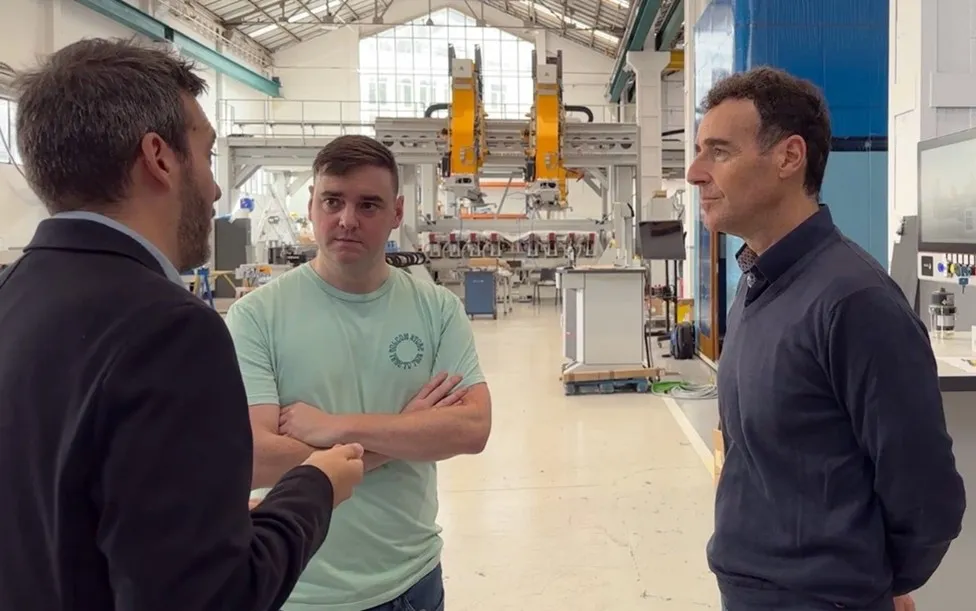
Interview with Sergio Teres, Technology Development Director, and Unai Beitia, Automation Manager, at Fagor Arrasate
Before making your decision, it is worth carefully reviewing some of the key costs associated with developing and maintaining your own platform:
- Staff costs: you will need at least four people working full-time, representing approximately 180,000 euros per year.
- Support and incident management: keeping the system operational and free from failures requires ongoing resources that usually exceed initial estimates.
- Operating system updates: regularly updating operating systems, databases and software licences, while ensuring their continued compatibility, involves significant recurring costs.
- Infrastructure costs: you need to consider software licences, databases, unforeseen Cloud service costs, such as unplanned traffic or data egress charges, and the need for infrastructure redundancy.
- Ongoing maintenance: the platform requires constant maintenance to ensure its correct operation, performance and cybersecurity.
- Additional costs caused by operational disruptions resulting from unforeseen failures.
- CAPEX VS OPEX: developing an internal platform involves a significant initial CAPEX investment that is difficult to justify, especially when the outcome is uncertain. Integrated solutions such as Savvy allow the cost to be managed as OPEX, reducing financial risk and the initial investment required.
- Know-how and associated risks: what happens if a key person on your internal team leaves the company? If a key member leaves the team, recovering that knowledge involves additional costs and delays.
- Opportunity cost: focusing resources on maintaining an internal platform limits your ability to concentrate on your core business.
Economic conclusion: On average, an integrated solution such as the one offered by Savvy can be up to 94% more cost-effective and 90% faster to deploy, with operating costs up to 70% lower. This allows you to scale your project more quickly.
Multiple solutions = less dependency? Probably not.
You may have chosen to integrate several digital solutions in a puzzle-like approach, either through external providers or internally, to avoid depending on a single IIoT provider. At first glance, this may seem like a flexible option, especially when choosing open technologies such as open-source Edge solutions. However, it is important to consider the challenges involved in this strategy:
- Hidden dependency: although you may choose open technologies with the intention of avoiding vendor lock-in, the reality is that dependency remains. You may depend on the integrator that designed the architecture, the internal technical specialists who maintain it or the provider of a key piece of the puzzle.
- Fragile integrations: puzzle-like platforms usually involve delicate integrations between different systems. What happens if something stops working after an update?
- Compatibility issues: multiple APIs, different product lifecycles, incompatible versions and misaligned standards increase technical complexity and the risk of operational failures.
- Lack of an overall view: managing multiple solutions can result in a fragmented view of your technology architecture, increasing the likelihood of errors, hidden technical support costs and loss of operational efficiency.
- Very weak data governance: architectures made up of different, disconnected technologies often create environments where data governance and cybersecurity are extremely difficult to manage and scale.
For this reason, integrated solutions based on open standards provide a more robust alternative, reducing unnecessary dependencies and allowing you to evolve more easily in the future.
Fast results (Time to value)
One of the main advantages of choosing an integrated industrial platform is how quickly you can start generating value. In our case, deployment can be completed in less than two weeks. From that moment onwards, you can begin capturing data and making decisions based on real information.
The example of Fagor Arrasate illustrates this point once again. While it took several years to connect ten installations using its internal platform, the company migrated all its legacy projects to our technology in just three months and now has more than 40 connected installations around the world.
This is the real meaning of "time to value": how much time passes between making the decision and starting to see tangible results. And, most importantly, what are you losing during that time? Opportunities, competitiveness and knowledge that other companies are already leveraging.
Furthermore, while puzzle-like platforms are often accompanied by fragmented, excessively technical and frequently outdated documentation, our solutions include clear, up-to-date and centralised documentation. This reduces the learning curve and makes it easier to onboard new users from the very first day.
Scaling should not become a second project
Many solutions work in a pilot project, but few are prepared to scale. We experienced this first-hand during a project with a company in the aerospace sector. Everything started well: sensors were installed, customised algorithms were developed and failures were detected before defective parts were produced. However, when the company tried to replicate the solution on other machines, the problems began: too much manual work, equipment-specific configurations and difficulties keeping the solution operational and consistent over time.
This is where real scalability, rather than theoretical scalability, comes into play. It is not enough to be able to capture data from one machine. You need to do it in an automated and repeatable way, without every new connection requiring weeks of work.
How did we solve it? With our industrial IIoT platform, the customer was able to manage assets centrally, apply templates to similar machines and deploy algorithms at the Edge without writing code. Everything was managed from the same environment and with a minimal learning curve. Processes that previously involved lengthy and tedious manual work can now be completed with just a few mouse clicks.
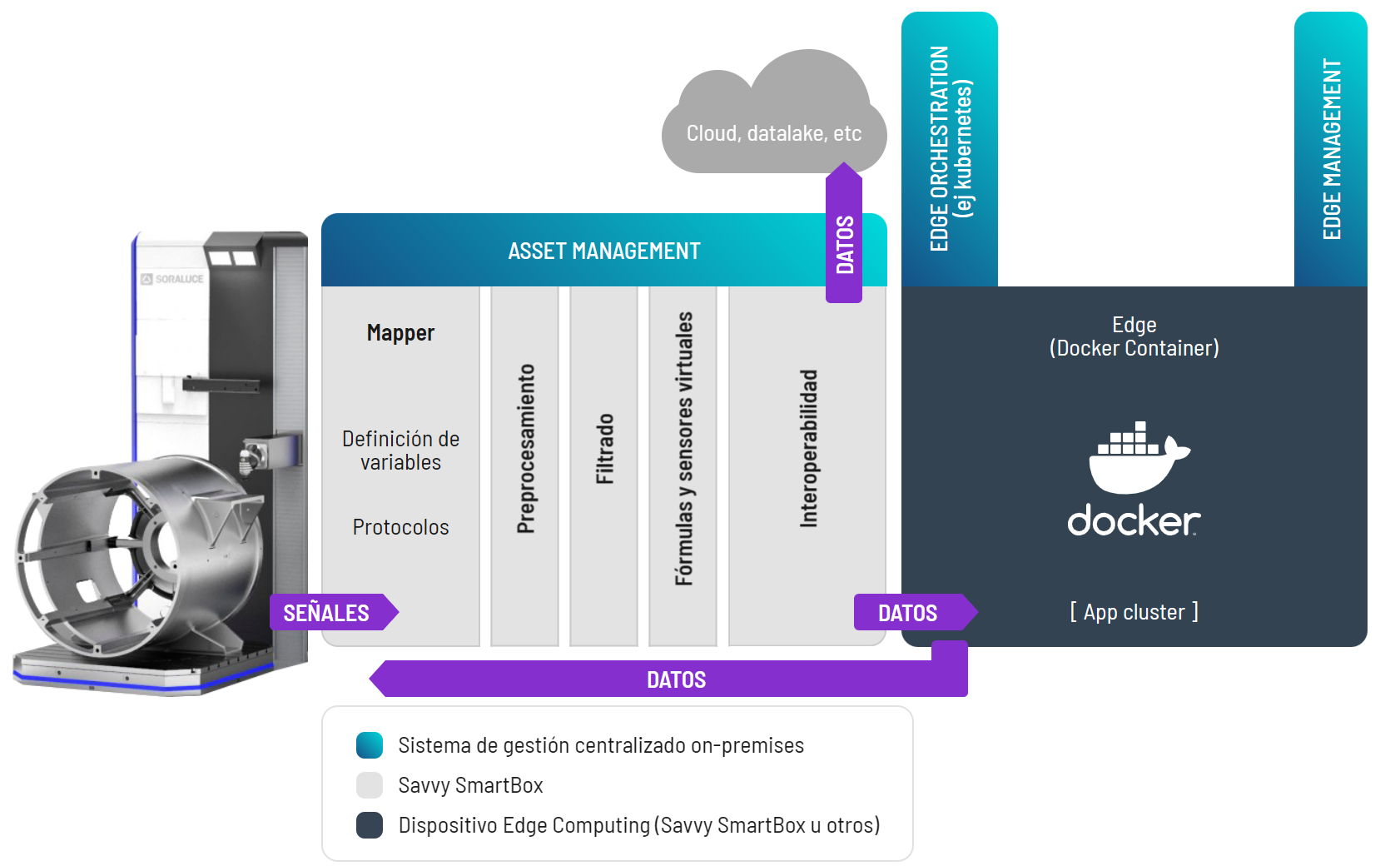
Furthermore, scaling is not only about increasing the number of machines, but also about managing greater complexity: signal capture, normalisation, preprocessing, virtual sensors, intelligent filtering and complete control over the data flow across the Edge, Fog and Cloud. This allows algorithms to run where they make the most sense and enables results to be visualised centrally without losing traceability.
In an industrial environment where technical resources are limited and time is extremely valuable, the ability to scale without friction makes all the difference.
An architecture that adapts to you,
not the other way around
Not all industrial applications have the same requirements. Some need to act directly on the machine within milliseconds, while others need to process large volumes of historical data for analysis or predictions. That is why choosing between Edge and Cloud means, in reality, not fully choosing at all.
Our platform allows applications to be deployed both at the Edge and in the Cloud, or in both at the same time, without complex reconfigurations or custom developments. You decide where each algorithm should run, depending on what makes the most sense for your process.
And what happens if you choose only one of the two options?
If you base your entire architecture on the Edge, you lose advanced analytics capabilities, historical storage and remote access. You also limit the possibility of integrating data from multiple machines or processes that need to be analysed together.
On the other hand, if you choose to operate exclusively in the Cloud, you sacrifice immediacy, resilience against network outages and the ability to close the control loop directly on the machine. In addition, you incur higher costs as a result of sending large volumes of data to an external processing centre.
With a hybrid solution, you get the best of both worlds: immediate local responses and a global view of your entire production system.
Integrated visualisation, beyond dashboards
Many IIoT solutions and industrial systems integrate visualisation tools such as Power BI, Grafana or other third-party applications. Although functional, these solutions are often disconnected from the rest of the platform, resulting in manual integrations, delays in accessing data or limitations when interacting with production processes in real time.
In contrast, Savvy has its own industrial Business Intelligence tool, fully integrated with the rest of its IIoT platform. What does this mean?
- Interface optimised for speed and performance: because it does not depend on intermediate layers or external connections, visualisations load faster and are always updated in real time.
- Consistent design (UX/UI): the entire experience is consistent for operators, supervisors and technicians, improving adoption and ease of use.
- Adapted to the industrial environment: specific KPIs connected to real-time plant data and customisable for each process or machine.
This integration ensures that both dashboard configuration and day-to-day use are perfectly aligned with plant operations, making it easier to take immediate operational decisions.
And most importantly: you decide what you see, how you see it… and who can see it.
Growing alone is difficult. Evolve with an ecosystem by your side.
In a constantly changing market, the ability to update, incorporate new functionalities and adapt to new standards makes the difference between moving forward and becoming stagnant. A platform that does not evolve quickly changes from being an enabler into an obstacle.
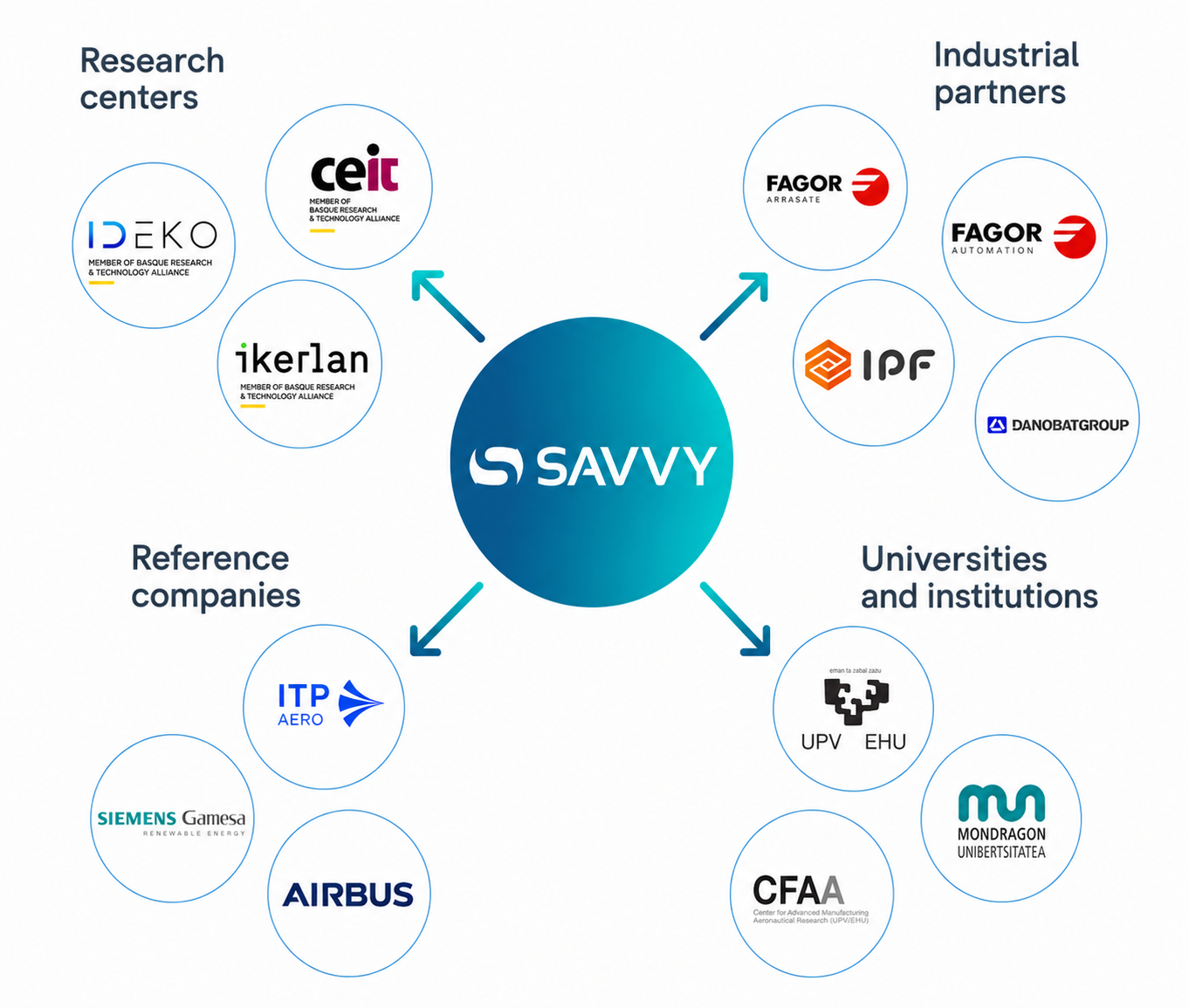
In our case, we provide continuous technological updates thanks to an active and diverse community made up of research centres, industrial partners and leading companies in their respective sectors. This enables continuous innovation that does not depend solely on us, but on a living ecosystem.
Here is a sample of the organisations that form part of this ecosystem:
- Research centres: Ikerlan, Ideko.
- Industrial partners: DanobatGroup, Fagor Automation, Fagor Arrasate, IPF.
- Leading companies: Airbus, Siemens Gamesa, ITP Aero.
- Universities and institutions: Mondragon Unibertsitatea, CFAA, UPV/EHU.
This collaborative approach allows the platform to evolve at the speed required by the industry, with continuous improvements that are made available to all its users.
Security and confidentiality
In an environment where industrial data is becoming increasingly valuable, protecting it is not optional: it is a priority. This is where a robust platform makes the difference.
- How is your data transmitted and stored? Our solutions guarantee encryption both in transit and at rest, minimising the risk of unauthorised access.
- Certifications: the Savvy platform holds specific cybersecurity certifications awarded by Spain’s National Cryptologic Centre: Common Criteria, ISO / IEC 15408 and ISO / IEC 18045. Compliant with IEC/62443.
- Data ownership: you decide what is done with your data. Our architecture respects data sovereignty, giving you complete control over who can access it, when and for what purpose.
- Centralised data governance: our platform enables all industrial data —regardless of its source— to be managed under clear and traceable rules: who can access it, with which permissions, for how long and for what purpose. This prevents the fragmentation commonly found in environments with multiple technologies and guarantees complete control over the data lifecycle, from its generation to its use.
What now?
Most industrial companies do not fail because of a lack of technology, but because they choose architectures that do not scale, consume too many resources and fail to generate value quickly enough.
It is no longer just about having an IIoT platform. It is about having the right one.
One that supports your processes instead of complicating them.
One that grows with you, without having to rebuild it every two years.
At Savvy, we help turn industrial complexity into data-driven decisions. Let’s talk about how to take your digital strategy to the next level without starting from scratch.
REQUEST A DEMO