A failure rarely happens overnight. Before it occurs, the machine usually gives signs that something is changing.
When a machine unexpectedly stops on your shop floor, your maintenance team has to react quickly: identify the problem, find the resources required and restore production as soon as possible. Yet many failures do not happen overnight. Before they occur, the machine usually gives signs that something is changing.
The challenge is that these signs do not always trigger an alarm. Vibration may rise slightly, a motor may consume more energy to perform the same operation, or cycle time may begin to vary. On their own, these deviations may seem unimportant. Taken together, they can indicate that a component is starting to deteriorate.
This is where predictive maintenance comes in.
What Is Industrial Predictive Maintenance?
Industrial predictive maintenance gives you insight into the actual condition of your assets through their operating data. It is not about predicting the exact moment when a machine will fail. It is about detecting changes in its behaviour early enough for you to investigate, prioritise and act before the issue leads to unplanned downtime.
This is why relying on thresholds alone has its limitations. An alarm is triggered when a variable exceeds a defined limit. However, an asset may already be deviating from its normal operating condition even though none of its signals has reached a critical value.
The key is to move beyond monitoring individual signals and understand the overall behaviour of each asset.
The Cost of Acting Too Late
In many companies, maintenance is still seen primarily as a cost to be contained. However, waiting until a failure becomes obvious also comes at a cost: unplanned downtime, emergency repairs, lost production or even missed customer commitments.
Predictive maintenance is therefore not about carrying out more interventions. It is about helping you intervene when there is real evidence that an asset is starting to deteriorate, before the impact becomes greater.
How Does Industrial Predictive Maintenance Work?
To address this challenge, you can build a digital fingerprint of an asset: a reference model of how it behaves when it is operating correctly.
This fingerprint can include variables such as vibration, temperature, energy consumption, pressure, torque or cycle time, as well as the context needed to interpret them. A signal does not mean the same thing under every operating condition.
For example, higher energy consumption may be expected while a motor performs a demanding operation, but not during an equivalent task it has normally carried out. Similarly, a vibration level may be normal at one speed and abnormal at another.
That is why collecting data is not enough. You need to relate it to the load, speed, cycle, product, tool or process stage in which it was generated. Only then can you compare a machine's actual behaviour with what should be expected under the same conditions.
This context is just as important when you apply advanced analytics or AI on the shop floor. Contextualised industrial data makes it possible to interpret a signal within the operational reality of each machine rather than in isolation.
An Example: From a Diagnostic Fingerprint to Predictive Maintenance
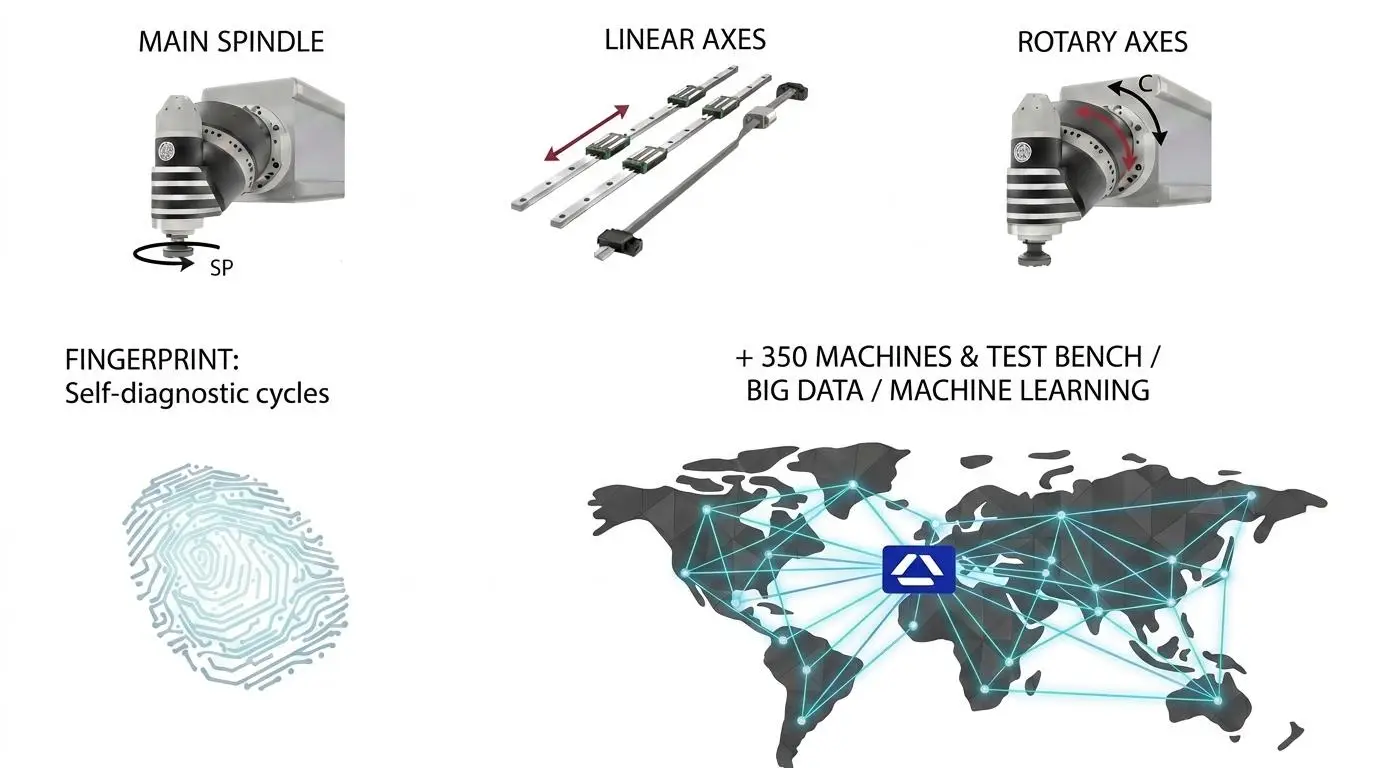
Danobat applies this approach to machine tools, focusing on critical components such as the main spindle and linear and rotary axes.
To assess their condition, the machines run test movements while data is collected from their components. These diagnostic cycles create a fingerprint: a reference for how the machine behaves when its mechanical components are in good condition.
Danobat combined information from test benches with data from a network of more than 350 connected machines. Using this historical data, it applied data analytics and machine learning techniques to identify behavioural patterns and understand how component wear evolved over time.
The outcome was a tool capable of detecting the early deterioration of critical components and estimating their remaining useful life. This allows customers to plan an intervention before the component fails.
The difference is significant. Following an unexpected failure, a machine could be out of operation for around four days while the problem was identified, the maintenance team was mobilised and the repair was carried out. By anticipating the failure, the same intervention can be organised as planned maintenance, reducing downtime to around four hours.
It is not simply about repairing faster. It is about preventing an unexpected incident from stopping production for days, with the operational and financial impact that entails.
An Alert Should Support a Decision, Not Create More Noise
Detecting an anomaly does not solve a maintenance problem on its own. For that information to add value, it should help you answer specific questions:
- Which asset should be checked first?
- What behaviour has changed?
- Under which operating conditions did the deviation occur?
- What could happen if the trend continues?
With this information, you can decide whether to monitor the trend, carry out an inspection, prepare an intervention or schedule downtime at the most suitable time for production.
In this way, predictive maintenance does not replace the experience of your shop-floor teams. It complements it with objective, continuous evidence that helps you prioritise more effectively.
When Detection Is Not Enough: Taking Action on the Machine
In some processes, detecting a deviation does not have to stop at an alert. When the asset's criticality and your operating rules allow it, that information can be sent to the machine control system to trigger a predefined action: limiting an operation, adjusting a parameter or stopping the process in a controlled way before the issue becomes more serious.
This is not about automating decisions without supervision. It is about establishing clear criteria that have been validated by your production and maintenance teams. This way, the system does more than report a deviation: it can also help you actively protect the asset and production.
Anticipate to Make Better Decisions
Your goal should not be to install more sensors or deploy an algorithm. It should be to reduce the uncertainty involved in maintenance decisions.
When your plant can identify early changes in the behaviour of its assets, it is better positioned to avoid higher-impact failures, reduce unplanned downtime and protect production availability.
At Savvy, we help you capture, contextualise and analyse industrial data, turning it into useful signals for maintenance, production and quality.
Do your shop-floor data help you understand when a machine or piece of equipment is starting to deviate from its usual behaviour?

Frequently Asked Questions About Predictive Maintenance
What data do you need for predictive maintenance?
It depends on the asset and the issue you want to anticipate. In many cases, you can start with data from the CNC or PLC and the sensors already installed, such as vibration, temperature, energy consumption, pressure, torque or cycle time. The important thing is to select the variables that help interpret the asset's condition and retain their operating context.
How does predictive maintenance differ from preventive maintenance?
Preventive maintenance schedules interventions according to a calendar or number of operating hours. Predictive maintenance, by contrast, relies on the asset's actual condition to detect when its behaviour begins to change. It can therefore help you intervene when there is evidence of deterioration, rather than simply because a scheduled date has arrived.