The problem with many industrial AI projects is not the model. It is that the model does not understand the factory.
There is a recurring trap that almost any factory falls into when starting out with artificial intelligence. The error occurs in minute one, when someone asks the seemingly logical question: What AI model should we use?
However, in manufacturing there is usually a much more important prior question: are your shop floor data ready for that model to understand what is happening?
Because an AI can analyze patterns, detect anomalies, or propose recommendations. But if it doesn't know which machine each data point comes from, in which shift it was generated, under which production order, with which reference, or what state the line was in, its ability to provide real value is greatly reduced. In industry, AI does not start with the algorithm; it starts with data. And more specifically, with contextualized industrial data.
What contextualizing industrial data means
Contextualizing industrial data means relating each shop floor signal, variable, or event to the information that allows it to be interpreted correctly. It is not just about capturing a measurement, but about understanding where it occurs, when it occurs, under what conditions, and what impact it can have.
Having this data: Temperature = 82°C is not the same as having this other data: temperature of 82°C on CNC-04, machining line, finishing operation, night shift, order OF-23891, 10 minutes before a vibration alarm.
Captured data tells you that something has happened. Connected data allows you to cross-reference it with other sources. Contextualized data helps you understand what it means within the process. And actionable data allows you to turn that context into an alert, a prediction, a recommendation, or a shop floor decision.
| Level |
What happens |
Value for AI |
| Captured data |
A signal is collected from a machine, sensor, PLC, or CNC |
Low |
| Connected data |
It is integrated with other industrial sources |
Medium |
| Contextualized data |
It is related to an asset, line, order, shift, batch, reference, state, or event |
High |
| Actionable data |
It is used for prediction, recommendation, alert, or shop floor decision |
Very high |
Why the Edge is key to preparing data for AI
Traditionally, many industrial architectures capture data on the shop floor and send it to higher layers to be analyzed later. This approach may work in some cases, but it can also cause the data to arrive late, incomplete, or separated from its original context.
The Edge changes this logic. By being close to the machine, it can become the first layer where industrial data begins to have meaning. It doesn't just capture signals: it can also filter, normalize, structure, and contextualize data before sending it to an analytical layer, an AI model, or a corporate system.
This helps reduce latency, improve data quality from the origin, avoid signals without operational meaning, reduce subsequent cleaning and integration work, and accelerate the time to value of AI use cases. Therefore, the Edge should not be seen only as a computing layer close to the machine; it can also be the first layer where industrial data is prepared to generate value.
From raw data to AI-ready data
The difference between capturing data and preparing it for AI is best understood with examples. These are situations we routinely see with industrial clients:
| Raw data |
Contextualized data at the Edge |
Use for AI |
| Temperature = 82°C |
CNC spindle temperature during a finishing operation, associated with the machine, reference, production order, shift, and process conditions. |
Detection of micro-deviations, predictive maintenance, and defect prevention before they affect critical parts. |
| Vibration = 4.6 mm/s |
Vibration of a specific spindle or motor, compared to its historical behavior, the type of operation, the tool used, and the operating duty. |
Early identification of wear, imbalances, or anomalous operating patterns. |
| Consumption = 240 kWh |
Energy consumption associated with the line, manufactured product, operating mode, shift, batch, and machine load level. |
Energy optimization, detection of anomalous consumption, and efficiency analysis by product or process. |
| Cycle time = 38 s |
Actual cycle of an operation compared to the expected standard, the manufactured reference, the machine, the operator, the batch, and the process conditions. |
Process optimization, deviation detection, and continuous improvement based on real shop floor data. |
| Scrap = 3 pieces |
Rejections associated with reference, batch, machine, shift, process parameters, previous alarms, and manufacturing conditions. |
Defect prediction, root-cause analysis, and reduction of waste and rework. |
Predictive AI and Generative AI: Two Different Uses, One Same Base
Predictive AI and generative AI can bring value to a factory, but they do so in different ways. On one hand, predictive AI seeks to anticipate events before they impact production: an unplanned downtime, a quality deviation, an anomalous energy consumption, or a drop in performance. Its goal is to help you act before the problem affects availability, OEE, quality, or operating cost. However, for that alert to be truly useful, it is not enough to detect that a variable is changing; you also need to know which machine it is happening on, what product was being manufactured, under what process conditions, which alarms appeared beforehand, and what impact that situation could have on the plant.
Something similar happens with generative AI. It can help you summarize incidents, explain deviations, consult technical documentation, or assist production and maintenance teams. However, if it does not understand the industrial context of the data, it can generate answers that seem correct but do not actually help make a decision. With contextualized data, a generative AI could answer questions much closer to the day-to-day operations of your factory:
- Why did the OEE drop yesterday on line 2?
- Which downtimes had the most impact during the night shift?
- Which alarms appear before an unplanned downtime?
- Which references consume the most energy per unit produced?
- Which recommendations should maintenance prioritize this week?
The difference is not just about using predictive AI or generative AI. It lies in the quality of the data feeding that AI. Without industrial context, an AI can generate a plausible answer. With contextualized data, it can help you understand what is happening on the shop floor, prioritize better, and turn that information into a useful decision.
How Savvy Helps Prepare Industrial Data for AI
At Savvy, industrial data is not treated just as a captured signal. It is structured from the Edge with industrial dimensions so that it can be used by advanced analytics, predictive AI, or generative AI. This allows moving from scattered data to information prepared for making shop floor decisions: detecting anomalies, analyzing downtimes, improving OEE, optimizing energy, anticipating incidents, or generating recommendations for production and maintenance.
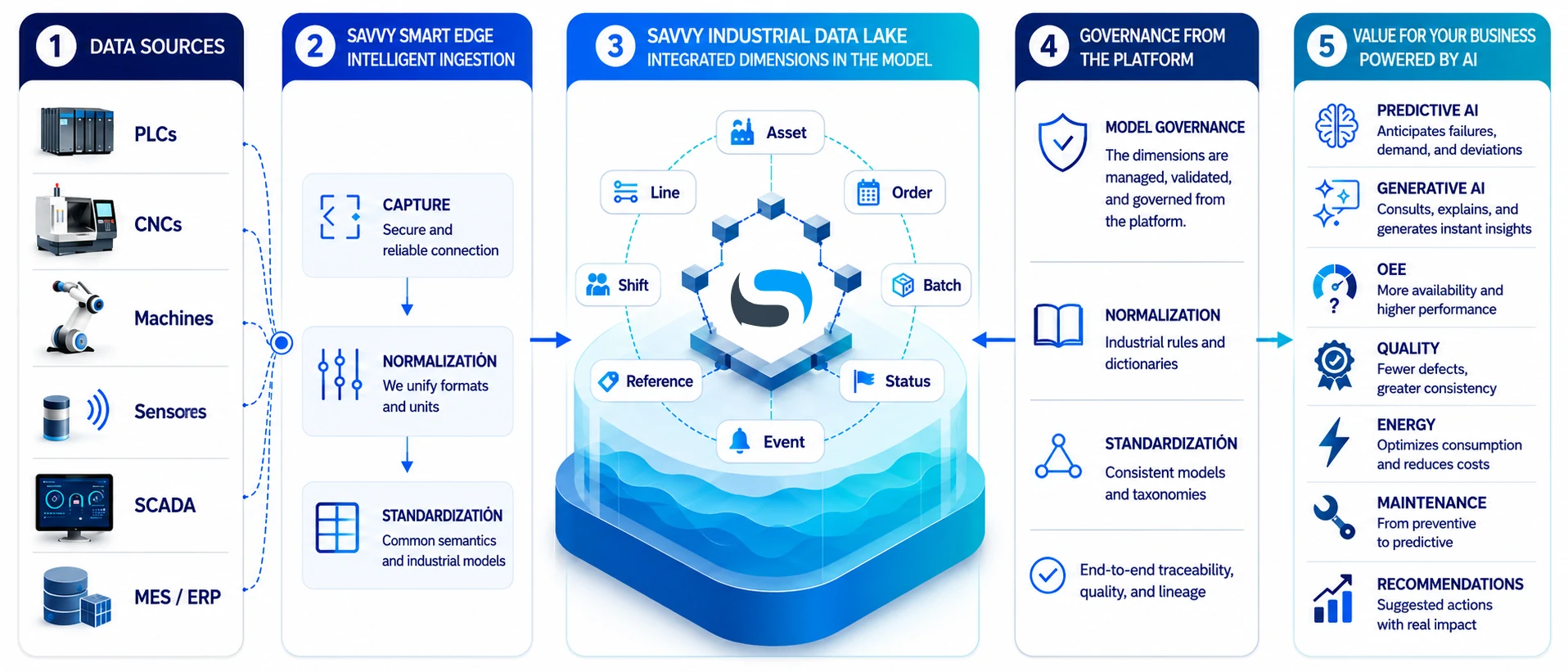
An industrial data architecture prepared for AI must allow capturing, normalizing, and contextualizing data from the source, connecting machines, systems, and processes to turn them into actionable information. At Savvy, industrial data is not treated as an isolated signal that later needs to be manually interpreted, cleaned, or reconstructed. The platform allows capturing, normalizing, and contextualizing data from the origin, integrating it into an industrial Data Lake where dimensions are part of the data model itself.
This is key for AI. Because storing millions of machine signals is not the same as having structured data by asset, line, order, shift, batch, reference, status, event, or process condition. When these dimensions are integrated into the model, the AI does not work on detached data points, but on industrial information prepared to be analyzed, compared, and exploited with much more value.
Furthermore, this dimension management is not left outside the platform nor does it depend on subsequent manual processes. It is governed from Savvy and integrated with data normalization and standardization mechanisms, allowing the construction of a common, coherent, and reusable foundation for various use cases: predictive analytics, generative AI, OEE, maintenance, quality, energy, or process optimization.
In this way, Savvy helps solve one of the major problems of industrial AI: having a lot of data but little context. With a data architecture prepared from the Edge and governed from the platform, your factory can move from scattered data to actionable information; that is, data that is not just stored, but understood, related, and turned into a solid foundation for making better shop floor decisions.
Conclusion: Industrial AI Starts Before the Model
Industrial AI does not generate value simply by applying an algorithm to shop floor data. It generates value when that data is reliable, connected, and preserves its operational context. Therefore, before asking what AI model your factory needs, you should ask yourself if your data is ready for that model to truly understand what is happening on the shop floor.
At Savvy, we help build that foundation: connected, structured industrial data prepared for advanced analytics, predictive AI, and generative AI.
Is your industrial data ready for AI?
REQUEST DEMO